

Where Does All The Church Money Go Pie Graph
You are here: Home / Blog
Michael Castrilli and Dr. Charles Zech of Villanova University's Center For Church Management won second place at the Catholic Press Association Awards for their book Parish Finance: Best Practices in Church Management. The book won in the "professional books" category of the competition, which features books on professional development with a Catholic context. These awards recognize the meaningful contributions of authors and publishers of Catholic work.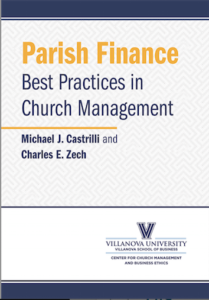
"It is a true honor to be recognized by the Catholic Press Association," said Castrilli, co-author of the book and Business Fellow of the CCM. "Our goal for this book is to offer a practical, user-friendly guide for priests, seminarians and parish managers to learn the essentials of church finance and we are excited to be recognized for delivering on this promise," he continued.
The book was praised by the Catholic Press Association for being extremely well outlined and providing a helpful overview on how to develop, understand and implement a church budget. It was noted as being a valuable tool to those both familiar and unfamiliar with the development of parish financial budgets, according to the Catholic Press Association.
"The recognition given to this book by the Catholic Press Association provides further acknowledgment of the increasing awareness of good financial stewardship in parishes, and in fact at all levels of the church," said Dr. Zech, co-author of the book. "We purposefully wrote it at a level of understanding for new pastors and seminarians which demonstrates that a priest need not be a trained accountant to understand parish finances in the process of carrying out his governance function."
"The collaboration of Mike Castrilli and Dr. Zech will provide unprecedented guidance in the field of parish financing and VSB is thrilled that their work has been recognized with this prestigious award," said Joyce E. A. Russell, PhD, the Helen and William O'Toole Dean of VSB.
Read the Church Management Academy Blog
There is powerful research that concludes that collaboration in fact yields results. James Surowiecki epic work, Wisdom of the Crowds , was groundbreaking in summarizing research that strongly supported the principle that "No one of us is smarter than all of us."
One example in the book, that I found particularly useful in helping me understand the benefits achieved through collaboration, comes from the television game show, Who Wants to Be a Millionaire, hosted by Regis Philbin.
During the show, contestants worked through trivia questions in their attempt to win $1,000,000. As a fun twist, if the contestant faced difficulty with answering a question, they had three options available. They were only allowed to use each option once, throughout their time on the show. The options included:
- 50-50 – The computer eliminates two of the incorrect answers, giving the contestant a fifty-fifty chance at the right response
- Phone-a-Friend – Prior to the show, contestants singled out someone they could call for help who they considered one of the smartest people they knew
- Poll the Audience – The studio audience would cast votes by computer
From the results* of the show, Surowiecki writes:
"Everything we think we know about intelligence suggests that the smart individual would offer the most help. And, in fact, the 'experts' did okay, offering the right answer – under pressure – almost 65% of the time. But they paled in comparison to the audiences. Those random crowds of people with nothing better to do on a weekday afternoon and sit in a TV studio picked the right answer 91% of the time…" (Wisdom of the Crowds, 2004, Page 4)
Tip 4: Collaboration is the glue of insightful leadership, shared-accountability, and results
What does this have to do with church budgeting? The show is just the fun example of the benfits of collaboration. But, collaborative budget processes and operational management does prove time and time again to yield results.
A budget that is developed by one or two people does nothing to build a broader spirit of shared accountability across the church. Many leaders feel they may lose control when they bring others into the budget process. However, management research proves that involvement by a team in financial matters, specifically people responsible for the finances of a particular area, will more likely lead to better results.
Why?
If someone is involved in the budget process, and they feel as if they have had the opportunity to offer feedback and input, they're more likely to "own" and "buy-in" to what has been created. Without participation in the process, resentment builds and can ultimately lead staff to consciously, or unconsciously, undermine what has been created.
Collaboration paired with open communication is where the budget will help church managers achieve the greatest potential of their organization.
Read more tips from Church Finance 30/30 – 30 Tips in 30 Days!
*Note: Surowiecki admits that this experiment would not stand scientific scrutiny. However, other examples in the book, would, in fact, support such an inquiry.
To complement a church financial report's narrative, a variety of church finance visuals can help enhance a report's readability and accessibility. I define the term "visuals" broadly, including any graphs, charts, pictures, tables, even art that displays data to accompany a concept, topic, or method. The Chinese proverb, a picture is worth a thousand words, speaks well for the impact visuals can have on virtually any report. Alternatively, I also like to say in fun, when you put together a visual and the picture is not worth at least 250 words, consider not including it!
Open up any word processing, spreadsheet, or presentation software and you will find an endless list of visuals that you can use. However, remember that beautiful colors, stylish charts or graphs may make a report look good, the question is whether the visual adds value to the information being conveyed? Another key question – what is the goal of including a particular visual?
Opportunities for Church Finance Visuals are Endless – Choose Well
Once the questions above are answered, there a variety of visuals you can choose. Without the time in this article to describe every visual available, over the next series of posts, I will discuss a few of the most common used in church financial reports.
As you can imagine, the choice of which visual to include for your particular situation will be subjective based on a variety of circumstances. There is not a one-size-fits-all solution, but there are some general parameters that you can use.
Pie Charts
Pie charts are useful when your goal is to present data on a category/topic as a percentage of the whole. Pie pieces can be easily arranged by color, shape, and highlighted to emphasize information.
Pie Chart Advantages
- The pie chart is easy to read, understand, and people are familiar with this visual.
- The pie chart is particularly useful to show relative proportions, or percentages of information.The use of colors and pie shapes display well any differentiation among categories.
- The use of colors and pie shapes display well any differentiation among categories.
Pie Chart Cautions
- Pie charts are often overused without regard to whether these charts are the best choice for displaying certain types of data. For example, a pie chart that offers no distinction between the data (unless this is a goal of your visual) does not add value to the report. If you have more than one data set, it can be difficult for people to look at multiple pie charts and make comparisons.
- The recommendation is to use a pie chart when you have between three and seven categories, otherwise, the pie chart may become messy and confusing.
- Avoid "miscellaneous" or "other" categories. These terms are confusing and can be misleading. If they are included, ensure that the definitions are clear.

Of course, pie charts are not your only choice. Learn the advantages and disadvantages of the infamous bar/column charts and line graphs!
Read More Church Finance Tips

At times, church budgeting can feel like learning a new language – new words, definitions, even new processes. Finance can feel like learning grammar for the first time. But, do not be afraid. I think it can look more intimidating than reality.
I am not saying that one can become a CPA overnight, but there is a great deal of empowerment that comes from learning the nuts and bolts of finance. This also means that depending on your role at your church, you will have to determine what is the right level of education you need to manage your church finances.
One of the main drivers that Dr. Chuck Zech and I wrote our book, Parish Finance: Best Practices in Church Management was to help pastors and parish administrators translate the language of financial management to their environment. I thought it might be helpful for me to put together a quick list of common terms to get people excited! Hopefully, some of these will help you translate this language and not feel overwhelmed, but empowered!
Accounting – Accounting is the systematic means of recording, managing, reporting, and communicating financial actions of an organization (Parish Finance, Chap 9).
Budget – Planning and management tool for executing priorities by projecting, allocating, and managing the money you receive and the money you plan to spend (Parish Finance, Chap 1).
Cash Flow Budget – Financial plan that displays anticipated actual income/receipts and expenditures for a given period. Unlike a linear budget that spreads income and expenses evenly over a period, the cash flow budget presents a realistic month-to-month (or week or day) projection of cash received and cash to be expended (Parish Finance, Chap 5).
Fiscal Year (abbreviated "FY") – Period of time for which an organization plans the use of funds and reports financial status (Parish Finance, Chap 2).
Financial Management – Planning, organizing, directing and controlling the financial activities of the organization. Focuses on generating financial information that can be used to improve decisions (Parish Finance, Chap 9)
Generally Accepted Accounting Principles (GAAP) – Set of rules that must be followed for the organization's financial statements to be deemed a fair presentation of the organization's financial position and results of operations (Parish Finance, Chap 9).
Internal Financial Controls –– a process for assuring achievement of an organization's objectives in operational effectiveness and efficiency, reliable financial reporting, and compliance with laws, regulations, and policies (Parish Finance, Chap. 8).
Master Budget – Comprehensive financial plan that includes operating and capital budgets and parish accounts and investments (Parish Finance, Chap 2).
Reallocation – The adjustment of resources between or within budget categories, also referred to as fund reprogramming (Parish Finance, Chap 7).
Segmentation of Duties – An approach to internal financial controls based on shared responsibilities related to the collection, deposit, disbursement, and reconciling of parish funds (Parish Finance, Chap 8).
Variance Analysis – Reporting tool to review, analyze, and take action based on the difference between budgeted and actual income and expenditures (Parish Finance, Chap 7).
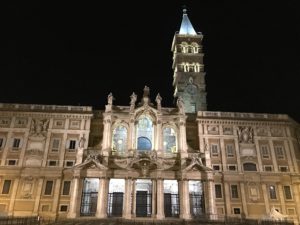
Church budget freedom may sound like an oxymoron, but it is not! Read on.
Money discussions are not always the most positive of conversations. When talking about finances, have you ever heard a married couple talking about a budget and say with enthusiasm, "Guess what, we have $100 more dollars in our budget this month spend!!! YAY."
More often is the case, what happens? There is a fight.
- "We have spent too much this month!"
- "How could you put that on the credit card?"
- "We are never going to catch up."
- "We can't afford this!"
- "Even though we budgeted $100, we can't really spend it!"
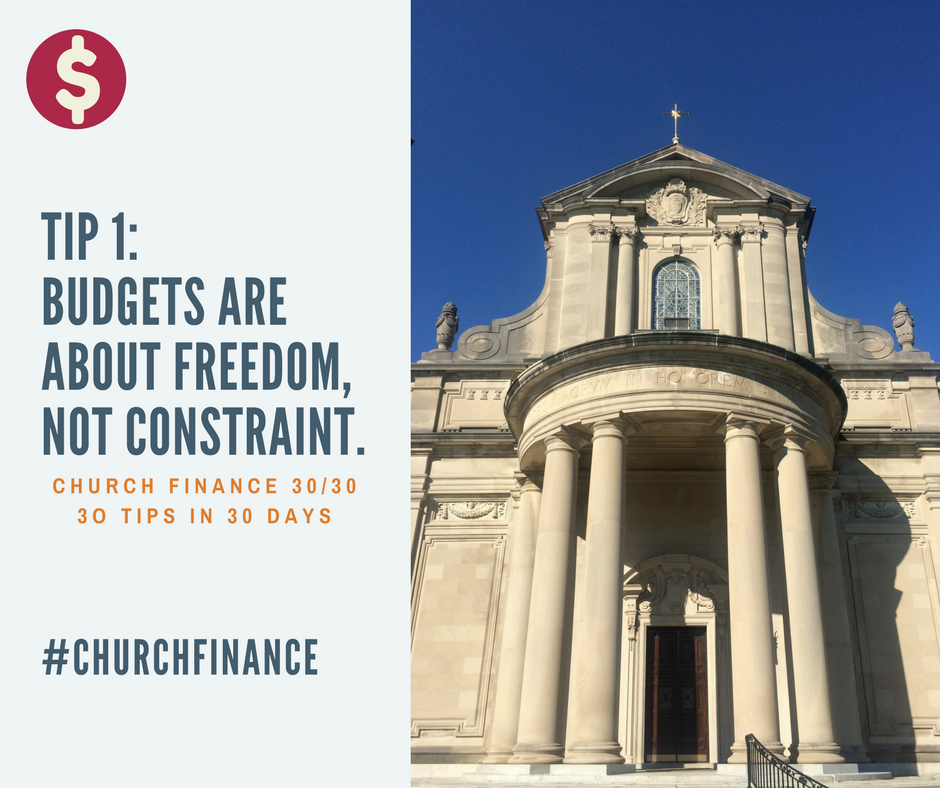
Although this may sound counterintuitive, budgets are actually about offering people and organizations freedom to make financial decisions.Yes, budgeting is about making limits clear, but it is also about enabling the church to allocate resources to the highest priority areas and accomplish pastoral goals.
Let's use the example of expenses. Budget freedom comes from knowing how much you have available to spend on a specific category (liturgical supplies, CCD books, vacation bible school), and then knowing that the money is, in fact, available to be spent.
Here is the key point – When a budget is created with the truth in mind – meaning being honest with how much you estimate that you really, truly have available to spend and being realistic about how much youreally, truly expect to receive – the budget becomes a tool and not a penalty stick.
Why put together a budget if you really don't want to spend the amount you have budgeted?
Some then argue, "BUT, what about saving money?" Great question!
If you want to save money, no need to always worry about it! Instead of hoping that the money you have budgeted for a given category is not actually spent – budget a new expense line item called – Transfer to Savings. This way, you have specified an amount of money for each month, that you have budgeted AND where you can feel great about spending the full amount.
Budget development cannot be about wishful thinking or hopeless estimating – it must be about the truth. Then, and only then, does the budget become a management tool, instead of a painful, anxiety-producing process and plan used to manage finances.
Free your mind and heart – change the conversation from constraint to freedom!
Read more about church budget freedom in our book: Parish Finance: Best Practices in Church Management.
Tip 1 is brought to you by the Church Finance 30/30 Series – Check back to the blog as I reveal my thirty favorite quick tips on the topics ministers struggle with most. We'll discuss budgeting, financial decision-making, safeguarding assets, and facilities management.
Where Does All The Church Money Go Pie Graph
Source: https://www.churchmanagementacademy.com/blog/page/2/
Posted by: fabryberoplike.blogspot.com
0 Response to "Where Does All The Church Money Go Pie Graph"
Post a Comment