

Asus GeForce RTX 3070 TUF Gaming and MSI GeForce RTX 3070 Gaming X Trio Review
If you're interested in learning how the GeForce RTX 3070 performs and compares to other GPUs, brand certain y'all check out our GPU review first. This commodity will exist less about functioning and more near Asus and MSI's custom RTX 3070 graphics cards, which will exist in direct competition to Nvidia'south own Founders Edition model which nosotros looked at days prior.
For this one we're going to focus on cooling design and thermal performance, overclocking and power. As a reference point, we should start with the Founders Edition model which is probable going to be one of the smaller RTX 3070 graphics cards you'll come up across. It measures just 241mm long which is a picayune shorter than the 2080 Ti Iron card which measured 267mm. We're using that case because both tend to evangelize the same level of functioning.
The RTX 3070 FE also weighs but 1035 grams, making it 22% lighter than the 2080 Ti model which weighed in at 1319 grams. Both are dual slot cards measuring 38mm wide in the example of the 3070. Certainly a small card considering the performance output. We take to say, like the other GeForce 30 series Founders Edition models, the 3070 version is very nice, sporting a rather elegant design that'll suit well-nigh builds well.

The only thing we don't like about the Fe model is the single 12-pin PCIe ability connector as most of you volition have to apply the supplied (and cheap) dual 8-pin adapter. On that annotation, the ability connector is in the eye of the card which is something y'all usually want to avert when factoring in the looks, as running power cables across the card is a affair slap-up freaks seem to really detest.
The idea here though is to allow Nvidia to open up the end of the card, assuasive air to pass through the heatsink and out of the backside of the card. There is a adequately large 67 x 88mm opening here and a lot of the air-menstruum from the second fan exhausts here. This design means the PCB is extremely modest, measuring but 165mm long, which is impressive given it houses the GA104 die, eight GDDR6 retentiveness fries and a VRM big enough to power those components.

On the backside of the card we find a full length backplate which protects the PCB below and part of information technology is used to transfer built up heat away from the PCB using a thermal pad. We'd have idea Nvidia would use more thermal pads hither, but apparently one volition practice the job. Then around at the I/O panel, we find the same configuration equally the Founders Edition 3080 and 3090 graphics cards: a single HDMI two.i port and three DisplayPort 1.4a outputs.
That'due south the Fe model, a very compact, smart looking 3070.
Asus GeForce RTX 3070 TUF Gaming

At present permit'southward take a look at the Asus TUF Gaming OC. This is a much larger graphics carte du jour, measuring 301mm long or 25% longer than the FE model. It stands 130mm tall, excluding the PCIe connector, making it 34% taller. As a 2.vii" slot carte it measures 52mm broad, making it 37% wider as well.
Given it'due south quite a bit wider, longer and taller, information technology might surprise you lot to larn that it only weighs eight% more at 1116 grams. I know I was surprised by merely how lite this graphics card is. When compared to the RTX 3080 TUF Gaming, we are looking at a heavily cut down cooler and PCB.


We do like how there's no plastic on the bill of fare though, besides the fans, of form. The fan shroud has been constructed from aluminum, giving information technology a premium look. Asus is also using axial-tech fans and since at that place are three in full, they've reversed the rotation of the outer fans to reduce turbulence. The fans each mensurate 90mm in bore. We should also note that the bill of fare includes a stop-fan characteristic which activates when the GPU drops below 55C.
The heatsink cools both the GPU and GDDR6 retentiveness every bit well every bit half the VRM, with the other half taken intendance of by a small heatspreader, which is besides used to strengthen the carte. Asus has gone with a x+2 ability phase pattern and the PCB measures 240mm long and features a pair of PCIe 8-pin power connectors.


On the back side of the carte we find an aluminum back plate which weighs 123 grams and is used to strengthen the card, though Asus has opted non to employ the backplate as a heatspreader so we find no thermal pads here. While this is a cut-down cooler to suit the $500 MSRP, overall it looks more capable than the FE model's mostly because information technology's physically much larger.
MSI GeForce RTX 3070 Gaming X Trio
Also on paw for testing we have the MSI RTX 3070 Gaming X Trio which is set to retail for $560. That'southward more expensive than the TUF Gaming, though information technology's larger and should provide meliorate thermal performance. The Gaming X Trio measures 323mm long or 7% larger than the Asus. Meridian wise they're virtually the same, and in terms of width it'due south 4mm wider at 56mm. The MSI is a suitably high-terminate looking graphics menu, and it feels high-end as well at 1463 grams.
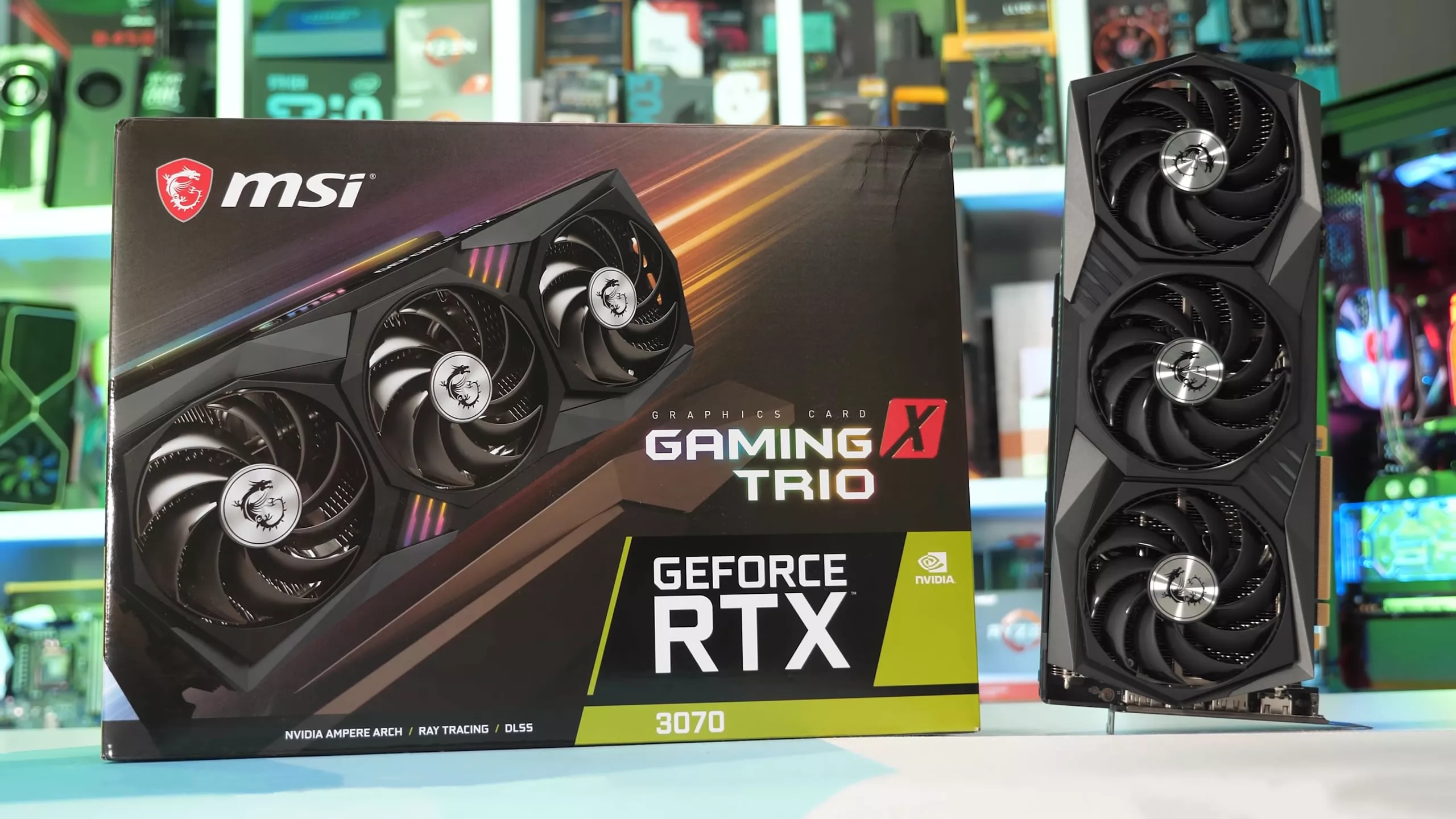
MSI is using their "Tri Frozr 2" cooler that packs three 90mm fans spinning in the same direction. Around the dorsum, nosotros notice some other MSI graphene backplate which is not something we were fans of on their 3080. Information technology feels plasticky and has very little tensile strength, then it does nothing to support the PCB.
Moving around to the I/O, we find the same basic configuration of the Fe model: a single HDMI 2.1 port and iii DisplayPort ane.4a outputs. A little disappointing given we got ii HDMI 2.1 ports on the TUF Gaming, but this probably won't be an outcome for most.


Taking the libation off reveals a cut-down version of what we found on the RTX 3080 version, but overall it'southward still substantial. The simply weakness is the VRM cooling which doesn't characteristic aluminum plates connected to the main heatsink and that's quite surprising to come across. Instead MSI has included a very minor heatsink over the ability stages, and using some thermal pads it poorly contacts with about half a dozen fins from the main heatsink. The GDDR6 cooling looks good though, as exercise the direct touch copper heatpipes for the GPU dice. Overall, we look this cooler to work well, though the VRM cooling could accept been much meliorate.


The PCB measures 260mm long, where we notice a 9 + 2 stage power blueprint. Whereas Asus had split upwards the VRM for better power distribution, MSI has crammed the entire VRM for the GPU on the left side of the card, so it volition be interesting to run across how hot this gets given the weak cooling. Finally, feeding power into the card are two 8-pin PCIe power connectors.
That's a quick await over these new RTX 3070 graphics cards, now information technology'south time to see how they perform, starting with out of the box operation.
Temperatures & Clock Speeds
For reference, the FE model peaked at 72C with a fan speed of 1700 RPM and averaged 1890 MHz. The MSI Gaming X Trio, on the other hand, peaks at simply 61C with a fan speed of just 1300 RPM and yet information technology maintained a clock speed of 1935 MHz, pregnant it ran substantially cooler and quieter while also being faster. Then we take the Asus TUF Gaming which peaked at 62C with a 1400 RPM fan speed and ran at 1935 MHz, which is also faster, cooler and quieter than the FE model.

Stock (in a higher place) and Overclocked (below) Stats
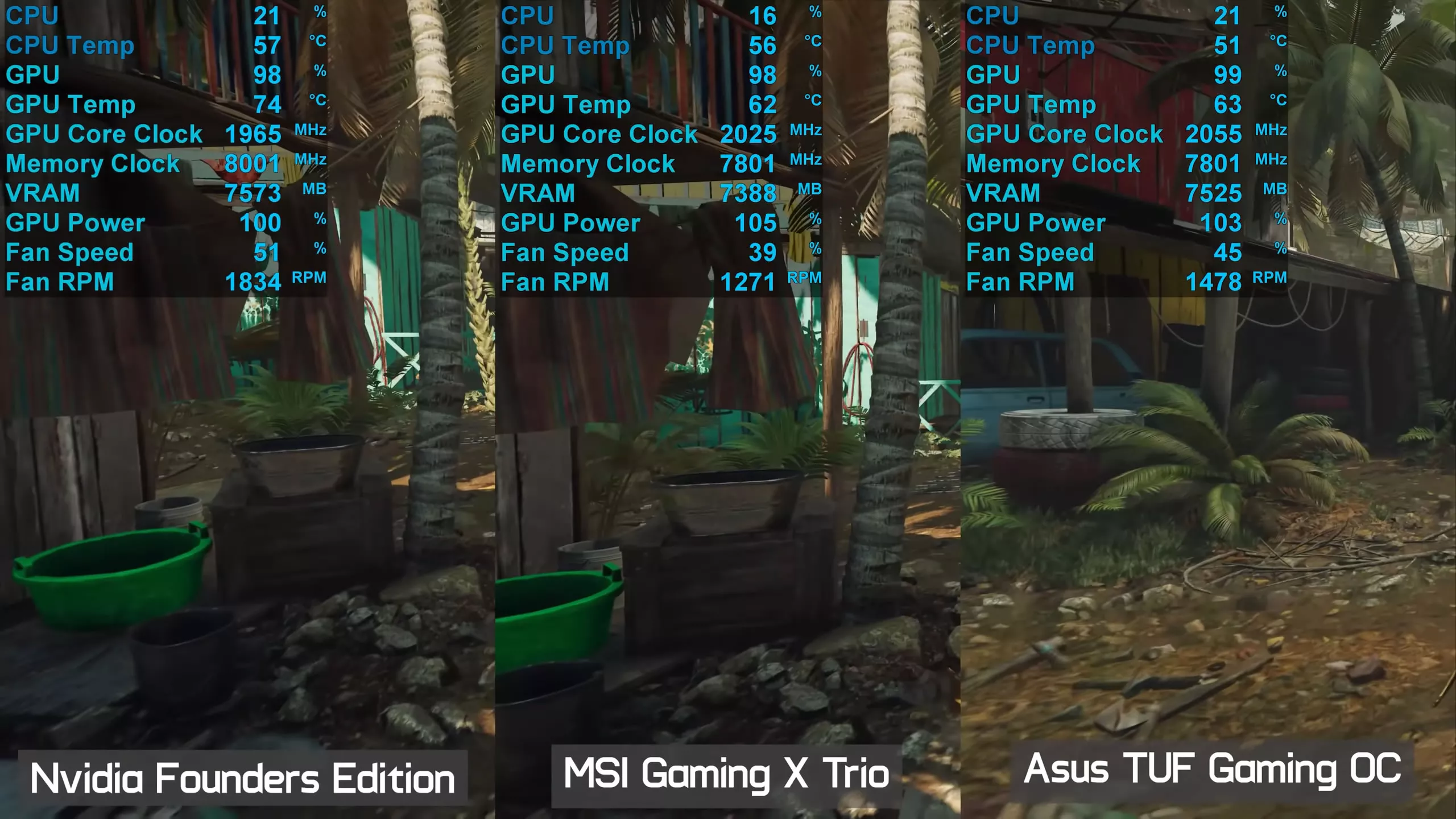
When overclocked the Founders Edition model runs at 74C with an 1800 RPM fan speed and averages 1980 MHz, only shy of ii GHz. The MSI Gaming 10 Trio clocks a little higher maintaining 2040 MHz, and despite that peaks at but 62C with the same 1300 RPM fan speed, very impressive. Asus also averages 2040 MHz with the TUF Gaming for the maximum OC, which sees the GPU run at up to 63C with a 1500 RPM fan speed.
Benchmarks
Overclocking headroom is non great on this GPU, with the current power limits the AIB cards averaged 2040 MHz in game which is a 5% increase over the stock clocks. Couple that with faster memory and y'all get a five to 6% FPS increment. That's all we accept to talk about here, then let's movement on.
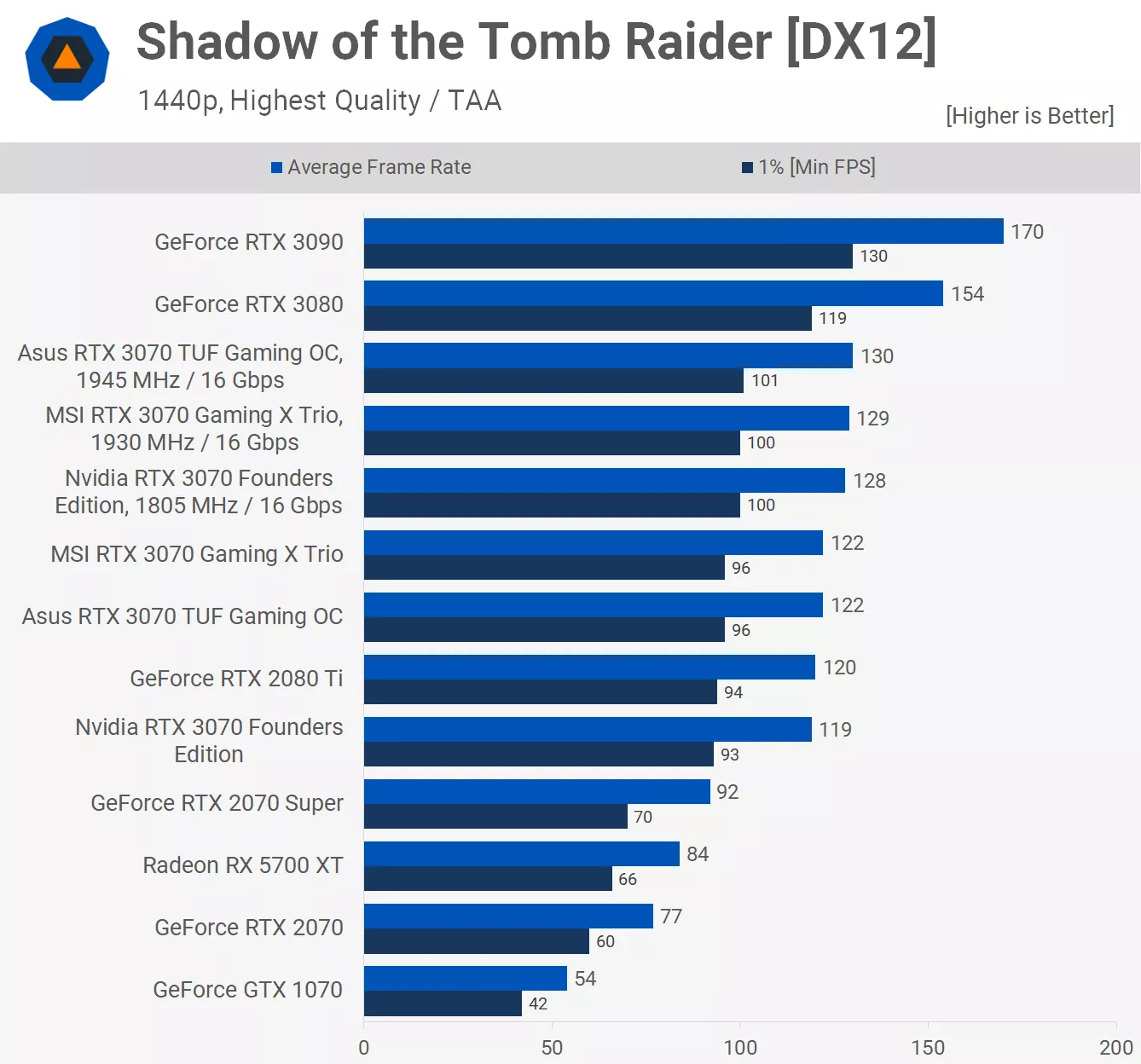
For that extra ~5% FPS boost you're looking at an 11-fourteen% power increase, which is not terrible but does make these custom RTX 3070 graphics cards less efficient. We're talking about a thirty watt increase in power draw.

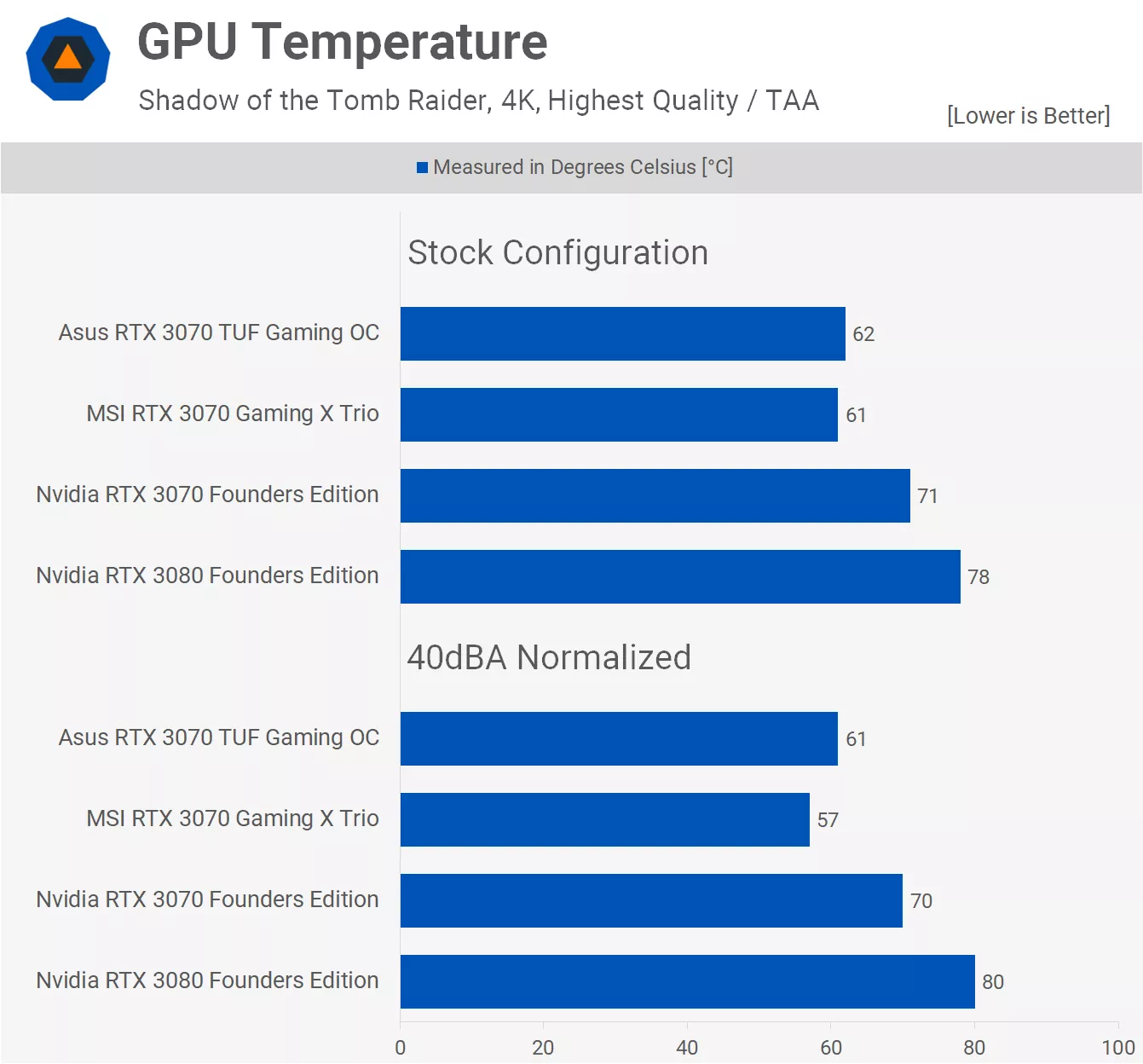
Here's a meliorate expect at GPU dice temperatures, both stock and dissonance normalized. Unsurprisingly the MSI Gaming X Trio is the winner here as it's the bigger, heavier carte, and therefore has more metal to misemploy heat with. That said, the Asus TUF Gaming ran a very close second at 62C out of the box and 61C once racket normalized, so at that point GPU temperatures offset to go somewhat irrelevant. Both were a reasonable improvement over the Founders Edition model and the MSI Gaming 10 Trio stacks up very nicely in the noise normalized testing.

Here's a await at the PCB temperature directly behind the GPU. The RTX 3070 graphics cards are significantly libation than the RTX 3080 FE. The MSI Gaming Ten Trio delivered the best results, only with all 3070s running at under 60C, they're really all winners.

The VRM temperatures are mostly expert, though we can't help but feel MSI could have done much better. Peaking at 74C out of the box is a very acceptable result, merely had they cooled these components better with the main heatsink we feel the Gaming X Trio would have beaten the TUF Gaming. In the end, Asus has done a better job of cooling the VRM.

Looking at GDDR retentiveness temperatures, this is another expanse where Asus has done extremely well keeping the TUF Gaming well below 60C. MSI could have done better, simply the results are still very good and well inside spec.
Wrap Up
Both the MSI RTX 3070 Gaming X Trio and Asus RTX 3070 TUF Gaming OC are expected to make it at around $560, which is a 12% markup from MSRP. This seems reasonable given how much cooler and quieter they run when compared to the Founders Edition board, which may only sell at the MSRP for trivial while and then disappear forever in traditional FE manner.

Asus has suggested that the base RTX 3070 TUF Gaming (the non-OC version) volition outset at $530 which seems like a better deal equally you can only overclock yourself if you care about getting that extra one-three FPS. MSI will offering the Ventus 2X OC at the $500 MSRP, but of course, that won't compare to the Gaming X Trio's cooling capabilities.
All in all, both Asus and MSI offerings are solid contenders though nosotros're leaning towards the Asus TUF in this comparing every bit it includes an all-aluminum design and most crucially, a dual BIOS option.
Shopping Shortcuts:
- Nvidia GeForce RTX 3070 on Amazon
- Asus RTX 3070 TUF Gaming on Amazon
- MSI RTX 3070 Gaming X Trio on Amazon
- Nvidia GeForce RTX 3080 on Amazon
- Nvidia GeForce RTX 3090 on Amazon
- AMD Ryzen nine 3950X on Amazon
- AMD Ryzen 9 3900X on Amazon

Source: https://www.techspot.com/review/2128-asus-tuf-msi-gaming-rtx-3070/
Posted by: fabryberoplike.blogspot.com
0 Response to "Asus GeForce RTX 3070 TUF Gaming and MSI GeForce RTX 3070 Gaming X Trio Review"
Post a Comment